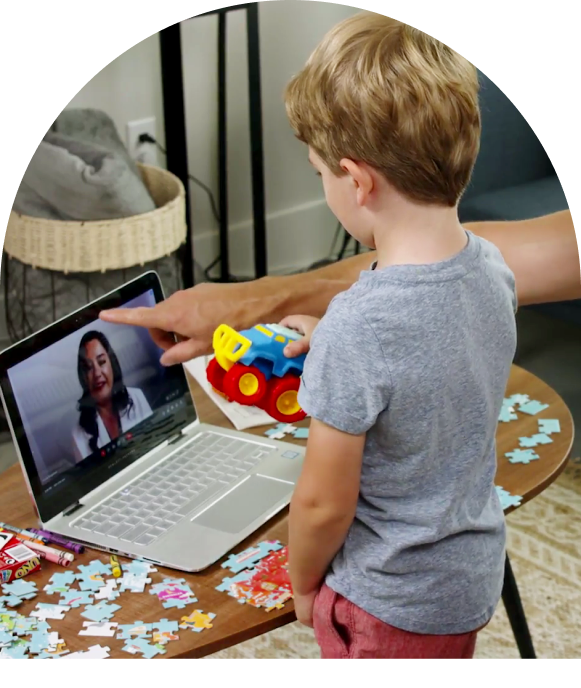
Your Toddler,
Our Expertise

Your Toddler,
Our Expertise

Parenthood is full of love, joy — and lots of questions. Every toddler develops

differently, and As You Are is here to help you understand each step. If you’re

concerned about your child’s behavior, communication, or social interactions,

you’re not alone.


The early signs of Autism Spectrum Disorder (ASD) can appear as early as 12-18 months, yet many parents aren’t sure how to talk about these behaviors. In fact,*76% of parents worry about their child’s social and emotional milestones.


That’s where our physicians come in. As You Are doctors provide virtual

autism evaluations for toddlers starting at 16 months, offering support from specialists who understand this stage of development.


Whether you’ve noticed repetitive behaviors, tantrums, communication delays,social challenges, picky eating, or GI issues — our compassionate doctors are here to help you understand what’s going on and what to do next.

70%

of kids diagnosed with ASD experience feeding and eating issues

50%

of kids diagnosed with ASD have chronic sleep issues

Kids with ASD

8x

More likely to have GI problems

Developmental Milestones

Every child develops at their own pace, but certain milestones can serve as important indicators of their overall development.

Social Differences

Limited interest in other children, infrequent eye contact, limited initiation of play

Repetitive Behaviour

Unusual finger or body movements, head-banging, rocking, strong restricted interests

Behavioural Outbursts

Severe tantrums or meltdowns, irritability, aggressive behaviors or self-injury

Sensory Differences

Easily upset by everyday sounds, over- or under-reacting to lights, smells, tastes

Speech Delays

Little to no babbling by 12 months, no single words by 16 months

Picky Eating

Refusing food, unwilling to try new foods, eating a limited variety

GI Challenges

Constipation, diarrhea, reflux, or feeding difficulties that affect daily comfort and growth

Important Milestones
for Your Child

Observing how your child plays, learns, communicates, behaves, and moves offers valuable insights into their growth journey.

18 Months

Most babies this age show social awareness, try early communication like pointing or saying simple words, imitate actions, play with toys, and reach physical milestones such as walking, scribbling, and feeding themselves.

2 Years

By this age, most children notice others’ emotions, use simple two-word phrases, point to objects when asked, engage in pretend play, and show physical skills like kicking a ball, running, and using utensils.

3 Years

By this age, most children calm after brief separations, engage in simple back-and-forth conversations, follow basic instructions, draw simple shapes, and show physical skills like stringing items, beginning to dress themselves, and using utensils.

4 Years

By this age, most children enjoy imaginative play, show empathy, follow basic safety rules, and adapt to different settings. They use four-word sentences, recall events, identify colors, follow simple stories, draw basic people, catch large balls, serve themselves with supervision, unbutton clothing, and hold writing tools properly.

5 Years

By this age, most children follow rules, enjoy creative activities, help with simple chores, tell multi-event stories, answer story questions, hold conversations, recognize rhymes, count to 10, use time words, focus for several minutes, write and identify some letters, and show physical skills like buttoning clothes and hopping on one foot.

Contact As You Are

Scheduling an evaluation is an important step in understanding

your toddler’s development. Our supportive team is here to

guide you, whether you need reassurance or next steps.


At As You Are, we believe every toddler deserves to be

understood and every parent deserves to be heard.

Our doctors provide the knowledge and resources you need to

feel confident. Don’t let concerns weigh on you—schedule an

evaluation today, and let’s help your toddler thrive.

What Our Patients Say

We accept major insurance

We accept most major insurance plans,

though coverage can vary by state and

by your child’s specific benefits.


We work with commercial plans,

TRICARE, Medicaid, and managed care

partners. Our team reviews your child’s

benefits with you before the first

appointment.

Some of our insurers include:

As Seen On

Scroll to Top