
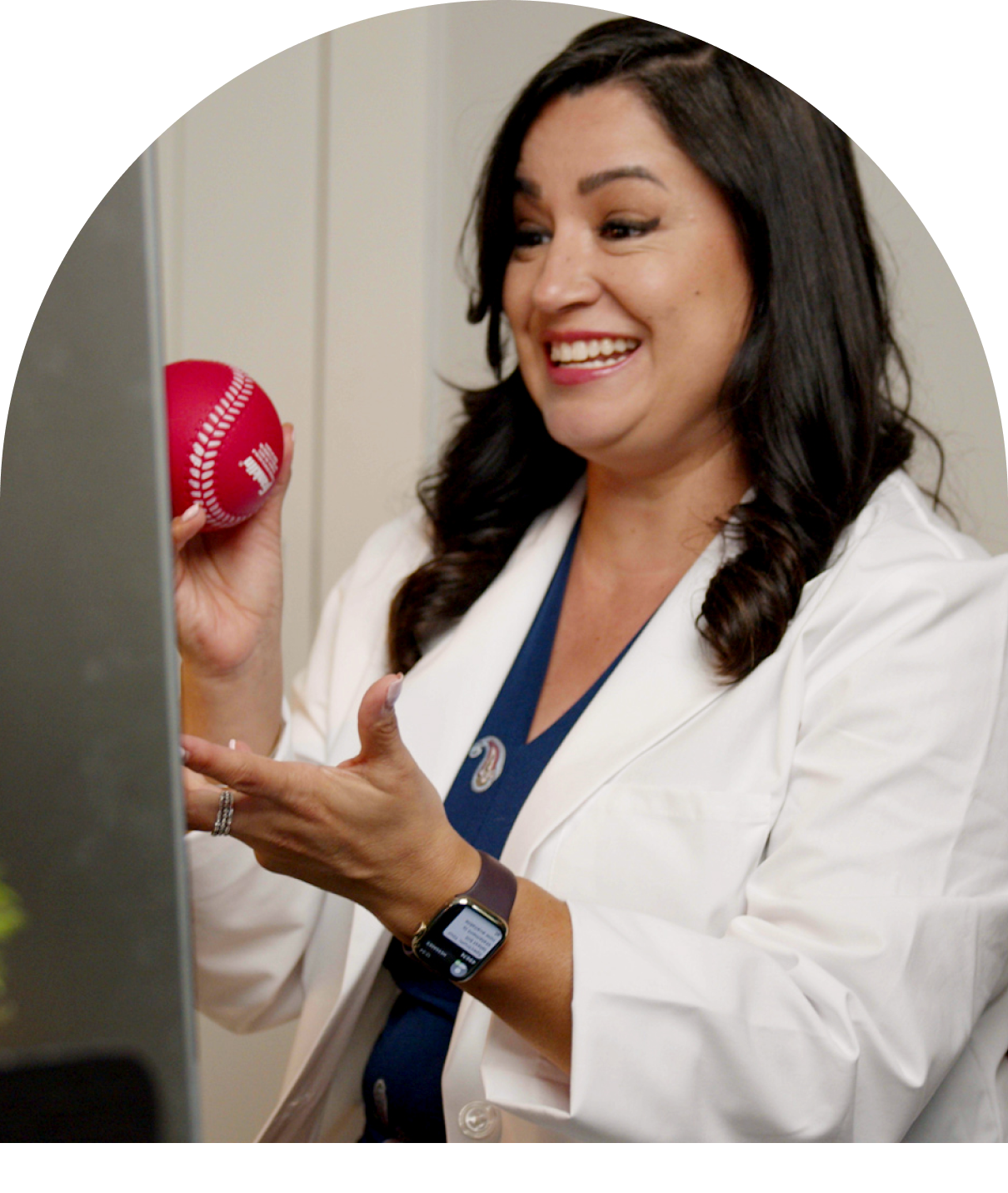






















Understanding your child starts here

Expert Virtual Autism evaluations for kids.

Virtual Autism evaluations for kids

As You Are is a virtual clinic with physicians who guide families through every step of the autism journey. We help determine whether your child’s behaviors align with autism or another diagnosis — giving you clarity, support, and resources to help them thrive.
No waitlist — appointments
available now
For kids ages
16 months–10 years
Virtual visits from home with a
dedicated physician
Insurance accepted, including
Medicaid and TRICARE (coverage
varies by state)
Upfront benefits
check before your first appointment
Ongoing support to help
families access care and
resources after diagnosis

Expert care made easy for families

Getting an official autism diagnosis early is essential for families to access timely treatment and support during a child’s key developmental years. As You Are, a virtual clinic, is transforming how families get evaluated — making the process faster and more accessible.

Watch TODAY’s NBC’s Blayne Alexander reports.

How It Works

Our three-step virtual evaluation helps families understand their child’s needs and get clear guidance, whether it’s autism or another developmental difference.

01.

Get Started

Families can schedule at AsYouAre.com, or providers can refer.

02.

Complete Questionnaire

Families fill out a short online form about their child’s development and health.

03.

Schedule Appointments

Families book the first of three virtual visits with their dedicated physician.

04.

Receive Results

The physician shares the diagnosis and next steps for care.

05.

Ongoing Support

Care Sidekicks™ connect families with resources and guide them after diagnosis.

Meet our Physicians

Meet our board-certified pediatricians — compassionate experts dedicated to your child’s care and well-being.

Dr. Alanna Albano

Pediatrician

Dr. Andrea Lambert

Pediatrician

Dr. David Valero

Pediatrician

Dr. Marisa Mendes

Pediatrician

Dr. Tami Heisler

Pediatrician

Dr. Tracy Burton

Pediatrician

Find a doctor
in your state

As You Are is now accepting patients in 48 states and Washington, DC! Find out which of our board-certified physicians are available in your state — explore the map to get started.

As Seen On

Family Reviews

From our family to yours — real experiences from real families

Does Insurance Cover an Autism Evaluation?

The cost question is a common reason families delay getting an evaluation.    Two very common questions we hear: “Will our insurance cover this” and “Do we really need this?” The honest answer is: it depends — on your specific plan, the state you’re in, and which providers are in your network. And it’s worth finding out before you assume it won’t. Insurance verification is built into our intake process. Our team reviews your benefits before your appointment happens, and if there’s an issue we work through your options together. You don’t have to figure it out alone first. Does insurance cover autism evaluations? For many families, the answer is at least partially yes — but coverage depends on your specific plan, the state you’re in, and which providers are in your network. Federal and state laws require most health plans to cover mental and behavioral health services, including diagnostic evaluations. Medicaid covers diagnostic services for eligible children in most states. Many employer-sponsored and marketplace plans include coverage as well — though the details vary widely by plan. The most important thing you can do is check before you assume. Coverage is more common than most families expect, and our team verifies your benefits before your appointment, so you know where you stand. Autism evaluations typically qualify as an eligible expense for Flexible Spending Accounts and Health Savings Accounts. If your FSA or HSA account includes a debit card, you can use it to pay directly at the time of service. If not, most plans allow you to pay out of pocket and submit receipts for reimbursement through your account. Does my child really need the evaluation first? Most insurance companies require a formal autism diagnosis before approving therapy services — ABA, speech-language therapy, occupational therapy, physical therapy. Without it, insurance won’t pay, even if a provider has already recommended those services. The evaluation is the document that makes those benefits accessible. What an autism diagnosis can unlock Insurance coverage for therapy: ABA, speech-language, occupational, and physical therapy are covered by many plans once a diagnosis is on file. Coverage amounts and prior authorization requirements vary by plan. School-based services: Under the Individuals with Disabilities Education Act (IDEA), public schools are required to provide educational services to children with disabilities. A formal diagnosis is typically the first steptoward an IEP and related accommodations. Requirements vary by state, but IDEA sets a federal floor that applies everywhere. What if my insurance doesn’t cover it? Out-of-network coverage: Your plan may still partially reimburse the evaluation. Call the member services number on your insurance card and ask before assuming nothing applies. Self-pay options: As You Are offers transparent self-pay pricing. Reachour team at [email protected] or 866-219-8595. If coverage was denied: You have the right to appeal. Our team can help you understand the process and what documentation to submit. How we handle insurance Start with our insurance coverage page to see which plans we work with in your state. From there, insurance verification is built into our intake process. Our team reviews your benefits before your appointment happens and follows up with what we find. If there are gaps, we work through your options together. Frequently Asked Questions Does Medicaid cover autism evaluations? Federal law requires Medicaid to cover medically necessary diagnostic services for children under 21. Coverage specifics — including which providers are in-network — vary by state and Medicaid plan. Check your state’s coverage at As You Are or contact our team to confirm. Does Blue Cross Blue Shield Cover autism evaluations? Coverage varies by state and by your specific plan. View our state-bystate coverage information or contact our team to confirm what applies to your plan. Does Aetna cover autism evaluations? Coverage depends on your specific Aetna plan and the state you’re in. Review our coverage information or contact our team before you schedule. Does United Healthcare cover autism evaluations? Coverage varies by state and by your specific United Healthcare plan. Check our coverage page or contact our team to confirm your benefits. Federal law requires Medicaid to cover medically necessary diagnostic services for children under 21. Coverage specifics — including which providers are in-network — vary by state and Medicaid plan. Check your state’s coverage at As You Are or contact our team to confirm. Coverage varies by state and by your specific plan. View our state-bystate coverage information or contact our team to confirm what applies to your plan. Coverage depends on your specific Aetna plan and the state you’re in. Review our coverage information or contact our team before you schedule. Coverage varies by state and by your specific United Healthcare plan. Check our coverage page or contact our team to confirm your benefits. How much does an autism evaluation cost without insurance? As You Are offers transparent self-pay pricing. Contact our patient support team at [email protected] or 866-219-8595 before you schedule. Does the evaluation have to be covered for therapy to be covered? Not necessarily. Coverage for the evaluation and coverage for therapy services are handled separately by most plans. Even if you paid out of pocket for an evaluation, the resulting diagnosis may still unlock covered therapy benefits. It’s worth checking. Will insurance cover ABA therapy after an autism diagnosis? Many private insurance plans and state Medicaid programs cover ABA therapy once a formal diagnosis is documented. Prior authorization is usually required, and coverage amounts vary by plan. The diagnosis is what starts that process. As You Are offers transparent self-pay pricing. Contact our patient support team at [email protected] or 866-219-8595 before you schedule. Not necessarily. Coverage for the evaluation and coverage for therapy services are handled separately by most plans. Even if you paid out of pocket for an evaluation, the resulting diagnosis may still unlock covered therapy benefits. It’s worth checking. Many private insurance plans and state Medicaid programs cover ABA therapy once a formal diagnosis is documented. Prior authorization is usually required, and coverage amounts vary by plan. The diagnosis is what starts


Read More »
Did You Know? Many Kids with Autism Have “Superpowers”!

Not Every Superpower Comes With a Cape!

A strengths-based look at what autism can look like in your child — and why the way we talk about it matters By Tracy Burton, MD Dr. Burton is a board-certified pediatrician who has spent the last decade diagnosing and treating children with autism. When a parent sits across from me after their child’s evaluation, the conversation almost always starts in the same place: the deficits. The gaps. The things their child isn’t doing yet, or isn’t doing the way other kids do. That’s partly because the diagnostic process is built that way. To meet criteria for autism spectrum disorder, a child has to demonstrate differences in communication, social interaction, and behavior. So the clinical language we use and the reports we write tend to lead with what’s harder for a child, not what comes easily to them. But here’s what I also know after a decade of doing this work: that deficit-forward lens tells an incomplete story. The kid who can’t make eye contact may be listening harder than anyone in the room. The child who seems lost in their own world has often built an inner landscape of extraordinary detail — whether that’s the entire taxonomy of dinosaurs, every train line in the city, or the exact lyrics of songs they heard once, months ago. The one who struggles with transitions may have a level of focus and precision that most adults would envy. These aren’t consolation prizes. They’re real, observable strengths. And they deserve to be named. What “strengths-based” actually means You may hear the term “strengths-based approach” and wonder if it’s just a feel-good reframe of a hard reality. It’s not. In practice, it means that therapy, education, and care planning all start from what a child can do — and use those strengths as the scaffolding for everything else. A child who is deeply passionate about a specific subject isn’t just humored; that interest becomes the bridge to building communication skills, social connection, and learning. It also means that the goal isn’t to make an autistic child act neurotypical. It’s to help them navigate the world in ways that feel authentic to who they are, while expanding their capacity to connect, communicate, and thrive. What this looks like at home You don’t need to be a therapist to bring this mindset into your daily life with your child. It starts with observation — noticing what genuinely lights your child up, what they return to again and again, what they’re good at even when things are hard. Then it means letting those things matter. Using them as entry points for connection. Celebrating what’s specific and remarkable about your kid, not just cheering progress toward a milestone. This isn’t about ignoring the hard stuff. Many of the families we work with at As You Are are navigating real challenges — sensory sensitivities, meltdowns, school difficulties, communication barriers. Those are real, and they deserve real support. But they’re not the whole story. And they’re not where we start. Your child is already more than their diagnosis. A diagnosis gives you a framework — a way to understand your child’s brain and access the support they need. But it doesn’t define the ceiling. And it doesn’t capture the full, complicated, remarkable person you’re raising. At As You Are, our evaluations are just the beginning. Through our CARE Hub and Care Sidekicks, we connect families with the ongoing support, resources, and care coordination they need long after the initial evaluation — because the journey doesn’t end with a report. If you’re just starting to navigate this, we’re here. Schedule an evaluation or learn more about what comes next.

Read More »
Reacting to An Autism Diagnosis

How to React to an Autism Diagnosis (There’s No Wrong Answer)

When the words finally come, nothing can fully prepare you. Here’s what to expect emotionally — and what to do next. By Samantha Sallade, PhD Dr. Sallade is a licensed school psychologist and Director of Clinical Operations at As You Are. She has spent her career evaluating children for autism and other neurodevelopmental differences. The moment a clinician says the words “autism spectrum disorder,” something shifts. Maybe you’ve suspected it for months. Maybe it comes as a complete surprise. Either way, there is no script for this moment — and no right or wrong way to respond to it. That’s one of the first things I want families to hear from me. In my experience, many parents spend enormous energy worrying about how they’re reacting — whether they’re grieving too much, or not enough, or whether relief is somehow the wrong thing to feel. It isn’t. All of it is normal. And all of it deserves space. “There’s no right or wrong way to react to an autism diagnosis. Feeling everything at once — or nothing at all — is a completely valid place to start.” There’s no script for this moment The news of an autism diagnosis lands differently for every family. Some parents cry. Some feel oddly calm. Some feel a wave of relief — finally, a name for what they’ve been seeing — immediately followed by fear about what that name means for their child’s future. Some don’t feel anything at first. That’s not denial or indifference. It’s your nervous system doing what it does when information is too large to process all at once. Your brain is protecting you, buying time. Grieving doesn’t mean you love your child any less. Relief doesn’t mean you wanted this. And numbness doesn’t mean you don’t care. The full range of human emotion belongs in this moment — and you’re allowed to feel all of it. What you might be feeling — and why it makes sense Most parents don’t experience one emotion after a diagnosis. They experience many — often simultaneously, often in no predictable order, often cycling back around. Here’s what that can look like: Shock. The words may not fully register in the room. You might find yourself nodding while your mind has gone somewhere else entirely. This is your brain’s protective response to information it needs more time to absorb. It doesn’t mean you weren’t listening — it means what you heard was significant. Numbness. A strange “this doesn’t feel real” quality can last for hours, days, or longer. It’s not a sign that you’re not processing — it’s often the first stage of how processing begins. Give it time. Fear. What does this mean for their future? Will they be able to make friends, learn at school, live independently someday? Fear about the unknown is one of the most universal responses parents describe — and one of the most human. The honest answer is: most kids with autism lead full, connected, meaningful lives. But that fear doesn’t disappear because of statistics, and it doesn’t need to. Grief. You may have had a picture in your mind of what your child’s life would look like — and the diagnosis can feel like a loss of that picture. That grief is real. It doesn’t mean your child’s life won’t be full and rich. It means you’re adjusting to a new version of what that looks like, and adjusting takes time. Shame or embarrassment. This one is harder to name out loud, but it’s real. Some parents worry what family members will think, or carry a quiet sense that they’ve somehow failed. To be direct: an autism diagnosis is not caused by anything you did or didn’t do. It does not reflect on your worth as a parent, or your child’s worth as a person. Full stop. Anger. At the diagnosis, at the process, at the time it took to get here, at the system that made it so hard. Anger is often a surface emotion sitting on top of something else — fear, grief, exhaustion, or some combination. It’s a valid part of the journey, and it usually means you care deeply. Relief. Many parents feel relief, sometimes more strongly than anything else — and then feel guilty for feeling it. After months or years of knowing something was different, finally having language for it, and a path forward, can feel like a weight lifting. You don’t need to apologize for that. Relief is not the same as wanting this. Hope. With a diagnosis comes access to support, services, and a community of people who understand what you’re navigating. Many families find that the period after a diagnosis is when things actually start to get better — because now you know what you’re working with, and you can start building toward it. What to do with all of it First: you don’t have to do anything with it right now. The immediate aftermath of a diagnosis is not the moment to make big decisions, research every therapy option, or figure everything out. Give yourself permission to simply be in it for a little while. What you can do is let yourself feel it. Talk to your partner, a close friend, or a therapist. Write it out if that helps. Find other parents who’ve been where you are — the community of families navigating life after an autism diagnosis is larger, warmer, and more welcoming than you might expect. When you’re ready, the next steps will start to come into focus. What does your child need right now? What support is available? Who can help you make sense of the options? You don’t have to answer all of those at once. When you feel ready to start thinking about what comes next, this is a good first step: What Happens After an Autism Diagnosis? → You don’t have to navigate this alone At As You Are, our evaluations are designed to give families more than a diagnostic

Read More »
AYA press release image - 50 states expansion

Virtual Autism Clinic ‘As You Are’ Expands to All 50 States

 As You Are is the nation’s largest virtual autism clinic, evaluating more than 1,000 children a month SAN ANTONIO, Jan. 3, 2024 /PRNewswire/ — The nation’s largest virtual autism clinic for kids, As You Are, announced today the expansion of services into its 50th state – making appointments available to families nationwide. On average, physicians at As […]

Read More »

Start your journey today

Schedule your child’s evaluation — no waitlist, no referral needed.
Scroll to Top